What Are Text Annotation Tools and Why Do They Matter?
Digital Marketing Manager with a deep fascination for the intersection of marketing technology and artificial intelligence. I'm currently on a learning journey exploring Large Language Models (LLMs) and their practical applications in automating and optimizing marketing workflows. I write about my discoveries in AI, digital marketing strategies in the age of AI, and how these powerful tools are shaping the future of the web.
Have you ever wondered how computers understand human language? How does Siri know what you're asking? How does Google translate work? The secret is something called text annotation. In this article, we'll explain what text annotation tools are in simple terms anyone can understand.
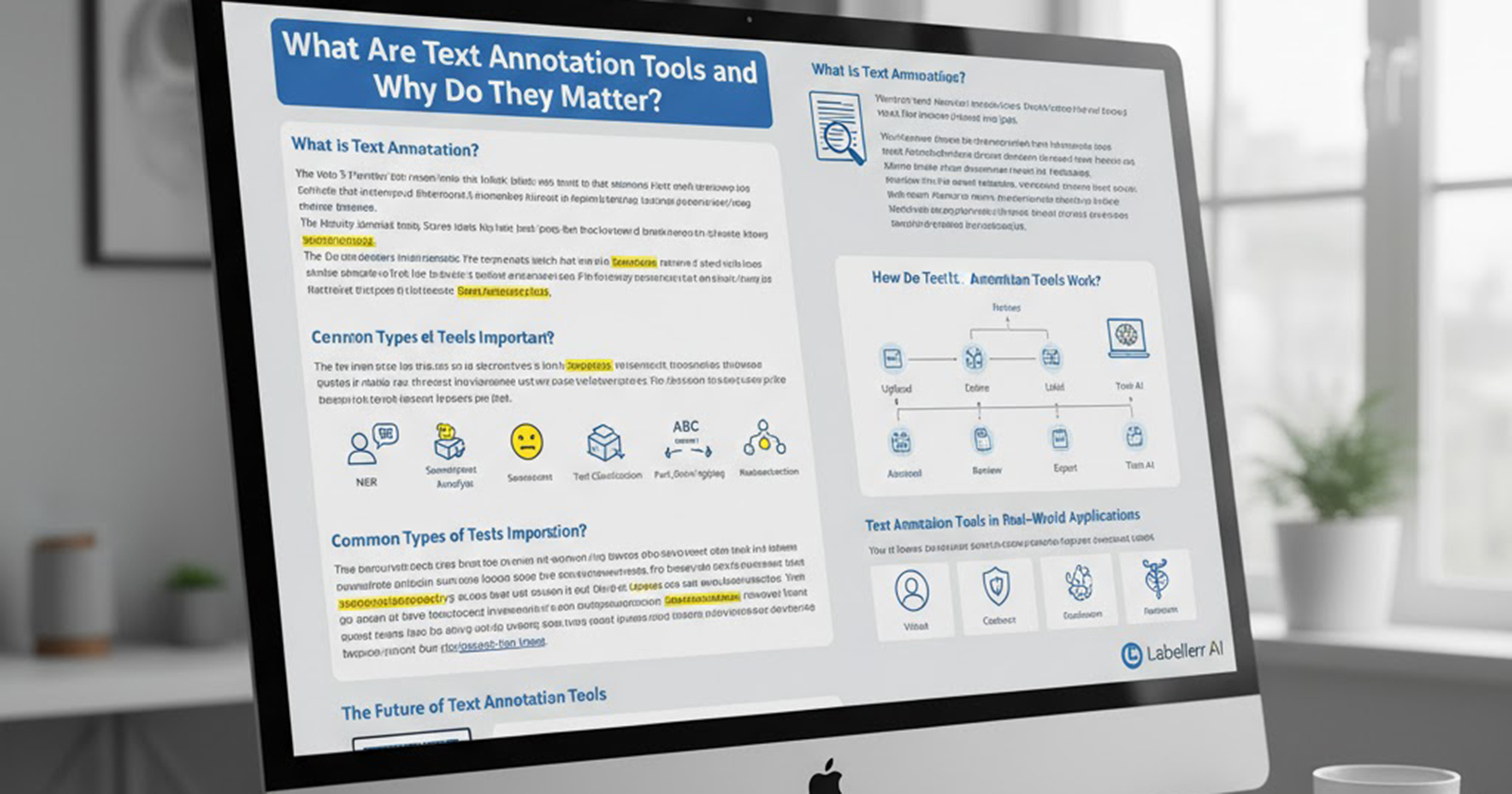
What Is Text Annotation?
Text annotation is the process of adding labels or tags to text to help computers understand human language. Think of it like highlighting important parts in a book, but for machines. People mark words, sentences, or paragraphs with special labels that tell computers what these words mean or how they relate to each other.
For example, if we have the sentence "Apple released a new iPhone," we might tag "Apple" as a company and "iPhone" as a product. This helps AI systems learn patterns and understand language better.
Why Are Text Annotation Tools Important?
Text annotation tools are crucial because they provide the training data that AI needs to understand human language. Without properly annotated text, AI systems would struggle with tasks like translation, sentiment analysis, and chatbot responses. These tools make the annotation process faster, more accurate, and scalable for large projects.
Just like you need good examples to learn something new, AI needs good examples to learn language. Text annotation tools create these examples efficiently.
Common Types of Text Annotation
Named Entity Recognition (NER): Finding and labeling names of people, places, organizations
Sentiment Analysis: Identifying if text expresses positive, negative, or neutral feelings
Text Classification: Categorizing entire documents into groups (like spam/not spam)
Part-of-Speech Tagging: Labeling words as nouns, verbs, adjectives, etc.
Relationship Extraction: Showing how different entities in text relate to each other
How Do Text Annotation Tools Work?
Most text annotation tools follow a similar process:
Upload your text data to the platform
Define what types of annotations you need (entities, sentiments, etc.)
Human annotators or AI models label the text according to your guidelines
Review and quality check the annotations
Export the labeled data to train your AI models
Advanced platforms like Labellerr AI use machine learning to speed up the process. Their AI can suggest annotations automatically, which human reviewers then verify. This human-in-the-loop approach combines AI speed with human accuracy.
What Makes a Good Text Annotation Tool?
Not all text annotation tools are created equal. Here's what to look for:
User-friendly interface: Easy for annotators to use without extensive training
Collaboration features: Multiple people can work on the same project
Quality control: Tools to ensure annotations are accurate and consistent
Integration capabilities: Works with your existing AI/ML workflows
Scalability: Can handle small and large projects efficiently
According to research from Harvard Data Science Review, the quality of training data is one of the most important factors in AI performance. This makes choosing the right annotation tool critical.
Text Annotation Tools in Real-World Applications
Text annotation isn't just an academic exercise - it powers many technologies we use every day:
Virtual Assistants
Siri, Alexa, and Google Assistant all rely on annotated text data to understand your questions and provide relevant answers.
Customer Service Chatbots
When you chat with customer support, annotation helps the AI understand your problem and route you to the right solution.
Content Moderation
Social media platforms use text annotation to identify and filter harmful content automatically.
Medical Research
Researchers annotate medical literature to help AI identify patterns and potential treatments faster.
The Forbes Technology Council notes that high-quality data annotation is becoming increasingly important as AI applications expand into more industries.
Challenges in Text Annotation
While text annotation tools make the process easier, there are still challenges:
Subjectivity: Different people might interpret the same text differently
Context understanding: Words can have different meanings in different contexts
Scale: Annotating large datasets takes time and resources
Consistency: Maintaining consistent labeling across large teams
Modern text annotation tools address these challenges with features like annotation guidelines, quality metrics, and AI-assisted labeling.
The Future of Text Annotation Tools
Text annotation is evolving quickly. Here are some trends to watch:
AI-Assisted Annotation
Tools like Labellerr AI are incorporating more AI to suggest annotations, reducing human workload while maintaining quality.
Active Learning
AI systems can now identify which examples would be most valuable to annotate next, making the process more efficient.
Cross-Modal Annotation
Annotating connections between text, images, and audio for more comprehensive AI understanding.
According to Gartner, the demand for data annotation services is growing rapidly as more companies adopt AI technologies.
Frequently Asked Questions
What's the difference between text annotation and text labeling?
These terms are often used interchangeably, but technically, labeling usually refers to assigning categories to entire documents, while annotation typically involves tagging specific parts of text.
Can text annotation be completely automated?
While AI can assist significantly, human review is still essential for quality, especially for complex or nuanced language. The best approach combines AI efficiency with human understanding.
How long does it take to annotate text data?
It depends on the complexity of the annotation task and the amount of data. Simple tasks might take seconds per document, while complex semantic analysis could take minutes. Using the right NLP labeling tool can dramatically speed up the process.
Getting Started with Text Annotation
If you're new to text annotation, here's a simple process to get started:
Define your annotation goals clearly
Create detailed annotation guidelines
Start with a small pilot project
Review and refine your approach
Scale up with the right tools and processes
Ready to explore text annotation for your AI projects? Discover how Labellerr AI's text data labeling tool can streamline your annotation workflow with AI-powered efficiency and human-quality results.
Text annotation might sound technical, but it's simply about teaching computers to understand our language better. With the right tools and approach, you can create high-quality training data that powers amazing AI applications.