Unlocking Multimodal Mastery: A Guide to Top Generative AI Datasets
Digital Marketing Manager with a deep fascination for the intersection of marketing technology and artificial intelligence. I'm currently on a learning journey exploring Large Language Models (LLMs) and their practical applications in automating and optimizing marketing workflows. I write about my discoveries in AI, digital marketing strategies in the age of AI, and how these powerful tools are shaping the future of the web.
Introduction
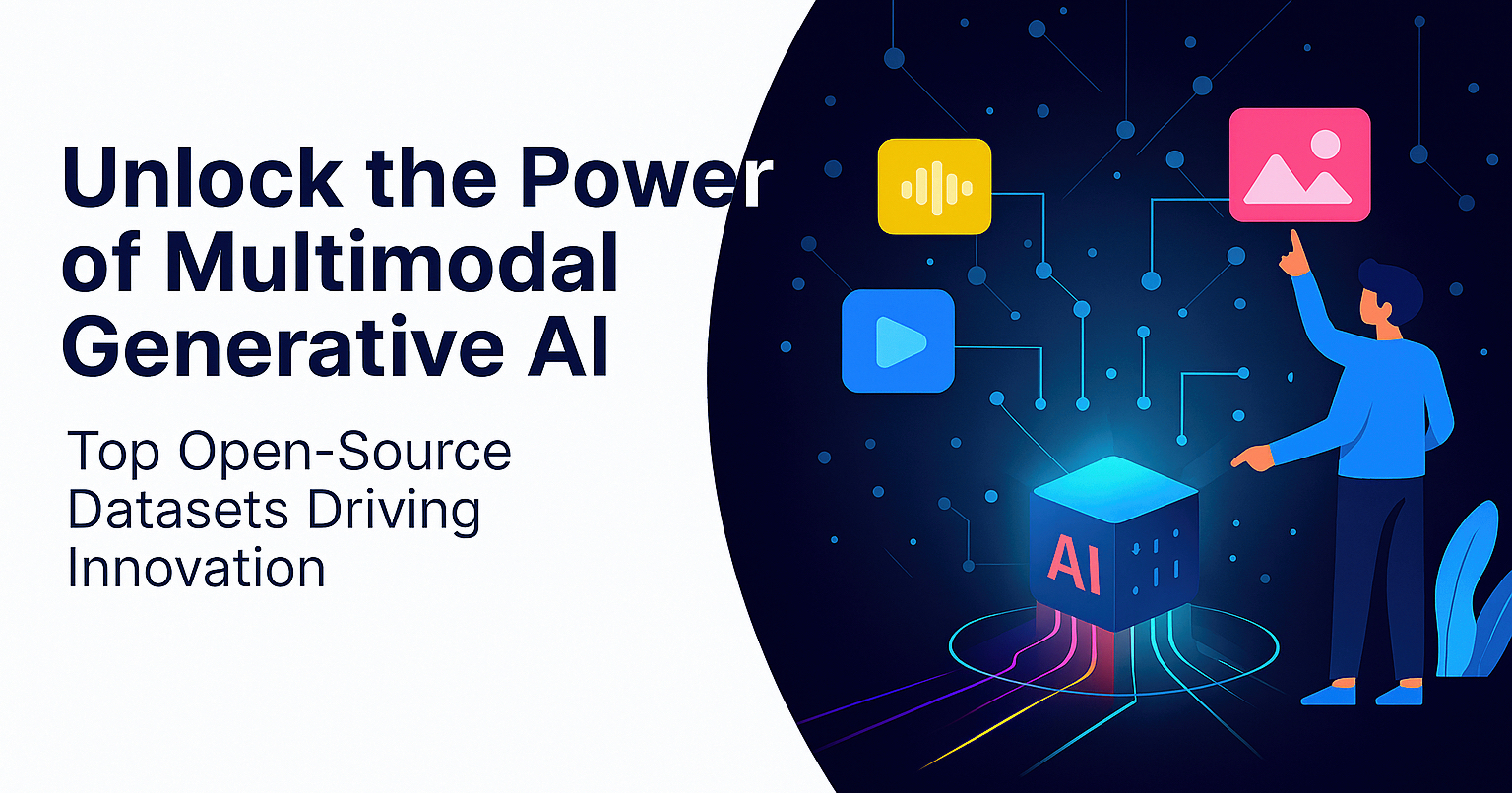
Today, artificial intelligence offers a versatile toolkit for many tasks. Imagine a single AI tool that can write content. It could also design visuals and compose music for your brand. This isn't a distant vision; it's the reality with multimodal generative AI. These models are a cutting-edge advancement in AI. They create content across modalities like text, images, and audio. This offers unprecedented creative possibilities.
Unlike traditional AI models, these models leverage different inputs. This allows them to generate richer, coherent outputs. It expands the possibilities of AI-driven creativity. These models empower tasks like image captioning and image creation. They can also generate images from speech. The AI system understands and creates integrated content.
By harnessing multimodal data, these models show immense promise. They enhance human-computer interactions and facilitate content creation. They also advance creative applications across various domains. These domains include art, design, and storytelling. Training these models requires vast amounts of data.
Open-source generative AI datasets democratize multimodal innovation. These datasets are the foundational building blocks. Sophisticated models are trained, refined, and validated on them. They provide rich multimodal data, including images, text, and audio. These datasets empower researchers and developers. The AI experts at Labellerr.com researched top open-source datasets.
These datasets are crucial due to their content and annotations. They also have broad applicability. They provide a mix of text, images, and audio. This allows for generating complex and meaningful content. This article explores these datasets and their technical insights. It also highlights their applications and potential for innovation.
Why are Multimodal Generative AI Models Important?
Multimodal generative AI models are a significant advancement. They bridge the gap between human perception and interaction. This creates a more natural and intuitive experience. Traditional models operate on a single data type. Multimodal models process and combine information. This information comes from various sources. It provides a more holistic understanding.
This allows for a better understanding of user intent. It enables generating outputs that blend different modalities. Imagine describing a scene with words and gestures. This conveys both visual and contextual information. Multimodal AI processes various inputs to create output. Processing text and a reference image generates output. This output could be a new image or video.
Examples of multimodal models include LLava, Mistral, and ImageBind. These AI systems analyze and combine text and images. They generate captions and answer questions about visual content. They can even create new images from text descriptions. The power lies in synthesizing information from multiple sources. This leads to more intelligent and creative outputs.
Top Open-Source Generative AI Datasets for Multimodal Models
The following open-source datasets are invaluable for training AI models. Each dataset offers unique strengths and caters to applications. This makes them essential tools for researchers.
1) InternVid
InternVid is an important resource among generative AI datasets. It is meticulously crafted to push video and text understanding. With 7 million videos and 234 million clips, it offers great depth. The clips are paired with generated captions. This depth is invaluable for training cutting-edge AI models. They can understand complex video content.
Technical Insights:
Multimodal Fusion: InternVid fuses video and text at scale. It presents a wealth of computational features. The dataset encapsulates the complexity of multimodal interactions. This includes video-text correlations and visual aesthetics.
Scene Diversity: Spanning 16 scenes and 6,000 actions, InternVid ensures coverage. This diversity enriches training and primes AI models. They will have robust performance across varied contexts.
Rich Descriptive Annotations: InternVid offers millions of clips with textual descriptions. These annotations empower machines to decipher instructions. They can also synthesize corresponding visual narratives.
Technical Applications:
Revolutionizing E-Learning: InternVid paves the way for a major change in e-learning. It creates interactive and engaging learning experiences. AI-powered systems generate personalized video tutorials. Textual analysis allows transitions between explanations and demonstrations.
Video-Centric Chatbots: InternVid empowers developing next-generation chatbots. They provide more immersive user experiences. AI models interpret textual prompts with video clips. This fosters a more engaging user experience.
Surveillance Systems: InternVid enhances surveillance systems, improving threat detection. AI models analyze video feeds and textual descriptions. This facilitates real-time threat detection and response.
2) Flickr30k Entities
Flickr30k Entities is an important dataset for visual stimuli and text. Beyond image-caption pairs, this dataset is a goldmine. It fosters understanding semantic connections in visual content. This dataset is valuable for training models to understand relationships.
Technical Insights:
Comprehensive Composition: It comprises 31,000 images with 5 reference sentences. Flickr30k Entities goes beyond traditional datasets. Its innovation lies in bounding boxes and entity mentions.
Annotation: Bounding boxes facilitate object localization within images. AI models learn and annotate objects accurately. This enhances the model's ability to understand content.
Enhanced Semantic Understanding: Textual and visual annotations allow greater comprehension. Models generate better descriptions and identify specific objects.
Technical Applications:
Real-time Image Accessibility: Flickr30k-trained models offer real-time image descriptions. This is tailored for visually impaired users, making information accessible. A smartphone camera points at an object. A voice description of what it is is immediately heard. This helps make information inclusive.
Revolutionizing Image Search: Training image search engines reduces the gap. This is between textual queries and visual content. User query descriptions enable more accurate searches.
Immersive Educational Experiences: The semantic richness of Flickr30k enhances learning. Developers create applications that improve the physical and digital realms.
3) MuSe
MuSe (Multimodal Semantic Understanding) processes human-like responses. This is across modalities like text, images, and audio. It features scenarios with annotations that contain human stress. The dataset supports dialogue generation and image captioning. This makes it an essential resource for multimodal AI. It is particularly useful in understanding human emotion.
Technical Insights:
Multimodal Fusion at Scale: MuSe integrates audio and visual recordings of individuals. Each recording is meticulously annotated with emotional content. This enables AI models to explore expressions of distress.
Emotional Annotation Enrichment: The raw data provide insights into stress expression. These annotations serve as a roadmap for AI models. They understand visual cues and subtle vocal audio.
Technical Applications:
Driver Drowsiness Detection: MuSe data in in-car systems detects driver drowsiness. This prevents accidents by triggering alerts. Drivers can pull over and rest, leveraging AI.
Workplace Wellness Initiatives: Companies gain insights into employee stress using MuSe. Organizations implement interventions, offering relaxation areas. This fosters a culture of well-being and resilience.
Dynamic Educational Platforms: Educational platforms use MuSe-trained AI to monitor student stress. Adaptive algorithms adjust learning materials. They recommend breaks based on stress levels.
4) VQA
The Visual Question Answering (VQA) dataset challenges AI models. They must answer questions based on images. It consists of images paired with questions. This requires understanding visual content and natural language. The questions range from identification to reasoning tasks. VQA improves capabilities in visual reasoning. It enables applications in interactive AI and content generation. This dataset is useful for understanding visual context.
Technical Insights:
Image Diversity: VQA datasets encompass a wide range of image types. This includes everyday scenes, objects, and abstract concepts. This ensures the model can generalize its understanding.
Question Formulation: How questions are formulated impacts model performance. Datasets include questions in natural language. They may also include grammatically correct questions.
Answer Grounding: Some datasets include annotations that "ground" the answer. This could involve bounding boxes or highlighting image regions.
Technical Applications:
Visually Aware Smart Assistants: A virtual assistant leverages VQA capabilities. It provides more intuitive and informative responses. You could ask about the flower's color. The assistant would analyze the image and answer accurately.
Interactive Visual Learning: VQA can revolutionize education for engaging experiences. Students could point a camera at textbooks. They receive real-time explanations from a VQA-powered system.
Enhanced Customer Support Chatbots: VQA datasets empower customer service chatbots. Users submit images of faulty products or instructions. The VQA-powered chatbot analyzes the image. It understands the issue and provides solutions.
5) Social IQ
Social IQ is a dataset created to understand social interactions. It uses multimodal inputs and includes scenarios. The scenarios show social contexts with dialogues and images. You can use this dataset to interpret emotions and intentions. It helps develop models that provide empathetic responses. Social IQ enhances the AI's ability to engage in conversations. This makes it vital for researchers exploring social intelligence. Social IQ can empower AI to understand social dynamics.
Technical Insights:
Multimodal Data: These datasets offer a complete understanding of situations. They consist of video recordings paired with questions. The videos capture real-world interactions. This includes visual cues, audio, and textual elements.
Open-Ended Questions: Social IQ datasets utilize open-ended questions. This tests a model's ability to infer meaning from cues. This pushes AI models beyond basic processing. They must grasp the dynamics of human interaction.
Grounded Inference: Social IQ datasets train AI models for "grounded inference." The model understands the social context behind them. It analyzes a handshake and infers the social purpose.
Technical Applications:
Personalized Social Media Feeds: Social media platforms curate content based on your emotional state. Social IQ data empowers AI to understand nuances. It personalizes your feed accordingly.
Emotionally Intelligent Chatbots: Customer service chatbots analyze a customer's sentiment. This is through text and vocal cues. The AI tailors its responses, offering empathetic support.
AI-powered Education: Social IQ datasets train AI tutors. They can identify a student's emotional state. This personalized approach can foster learning.
6) RGB-D Object Dataset
The RGB-D Object Dataset supports training AI models. They use RGB (color) and depth (D) information. It features objects captured in color and depth. It also provides annotations like class labels and 3D pose data. This approach can be used in object recognition. It allows models to better understand their environment. RGB-D Object Dataset enhances its use in robotics and AR. This dataset enables accurate object recognition.
Technical Depth:
Beyond RGB Channels: The RGB-D Object Dataset incorporates depth data. Depth sensors measure the distance of each pixel. This creates a 3D representation of the scene. This is crucial for 3D object recognition. AI models understand shape and size.
Precise Object Localization: Depth data allows models to pinpoint object locations. This is essential for robotic grasping and manipulation.
Sensor Calibration: The dataset provides calibrated RGB and depth channels. This ensures perfect alignment for 3D reconstruction.
Multiple Viewpoints: Each object is captured from different viewpoints. This provides a comprehensive understanding of the object's structure. This is beneficial for tasks where object orientation is crucial.
Technical Applications:
Enhanced Smart Home Systems: RGB-D Object Dataset revolutionizes smart home ecosystems. It enables real-time object recognition and interaction. AI-powered systems identify objects. They facilitate intuitive commands with precision.
Real-time Robotic Autonomy: Robotics enters a new era with RGB-D Object Dataset. Robots can navigate and manipulate their environments with precision.
Expanding Horizons with Synthetic Data
While open-source datasets are valuable, synthetic data is a complement. Synthetic data is artificially generated data. It mimics the characteristics of real-world data. Bernard Marr highlights the rising importance of synthetic data.
Synthetic data overcomes challenges associated with data collection. It bypasses privacy concerns and the high costs. Generative AI tools create synthetic data across modalities. Mostly AI generates data that mimics the real world. It ensures privacy and compliance with regulations. Gretel AI simplifies the creation of tabular and time-series data. Synthea generates synthetic patients for healthcare analytics.
Tonic AI offers a platform for developing realistic synthetic data. Faker provides libraries for creating fake data. As AI evolves, synthetic data will play an important role. It will train robust and versatile multimodal models.
The role of Labellerr AI in Multimodal Data Annotation
Labellerr AI plays a crucial role in the annotation process. It offers tools and services to streamline data preparation. High-quality annotations are essential for training AI models. Labellerr AI provides solutions for image, text, audio, and video annotation. This ensures data is accurately and consistently labeled. With Labellerr AI, researchers accelerate their AI projects. They leverage expert annotation services to create datasets.
The team at Labellerr AI understands the intricacies of annotation. The company helps organizations overcome data preparation challenges. By providing tailored solutions, Labellerr AI empowers AI teams. They can focus on model development and innovation.
Conclusion
The open-source datasets are crucial for companies. They enhance their AI models with diverse, high-quality data. This improves the training of multimodal generative AI models. By leveraging these resources, companies can unlock innovation. This is across natural language processing and multimedia content.
As AI advances, integrating these datasets will drive progress. It will open up new possibilities. If you're also looking to push the boundaries of AI, these datasets are valuable. If you need assistance or have questions, Labellerr is here to help. Reach out for expert support to make the most of your projects. You can explore other multimodal datasets here.
Frequently Asked Questions
Q1) What are multimodal generative AI models?
Multimodal generative AI models are advanced AI systems. They understand and generate content across modalities. These models leverage different data types. This produces richer and more coherent outputs.
Q2) Why are multimodal generative models important?
Multimodal generative models enable more natural interactions. They facilitate a holistic understanding of multimodal data. They unlock new possibilities for innovation. This is in areas such as assistive technologies and design.
Q3) What role do open-source generative AI datasets play?
Open-source generative AI datasets serve as resources. They provide diverse collections of multimodal data. This enables building robust models without proprietary datasets.