How Image Annotation Services Power Self-Driving Cars
Digital Marketing Manager with a deep fascination for the intersection of marketing technology and artificial intelligence. I'm currently on a learning journey exploring Large Language Models (LLMs) and their practical applications in automating and optimizing marketing workflows. I write about my discoveries in AI, digital marketing strategies in the age of AI, and how these powerful tools are shaping the future of the web.
Have you ever seen a car driving with no one behind the wheel? That's an autonomous vehicle. These amazing cars use cameras and sensors to see the road. But how do they know what they're looking at? The answer is image annotation services. This article explains how image annotation makes self-driving cars possible.
What Do Self-Driving Cars See?
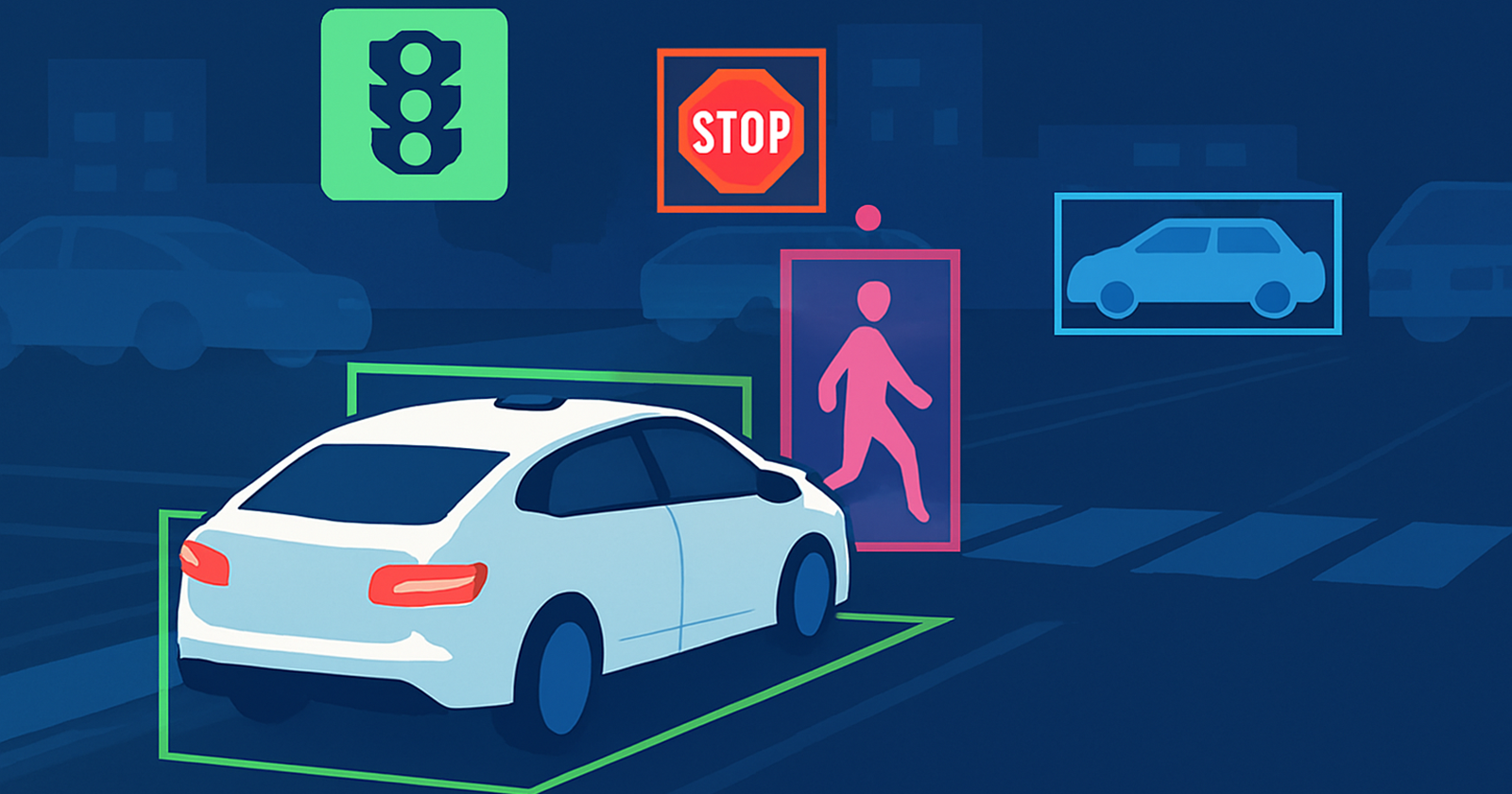
Self-driving cars see the world through cameras and sensors, but they need image annotation to understand what they're seeing. Image annotation services label objects like pedestrians, other cars, traffic signs, and road markings in thousands of images. This training helps the car's AI brain recognize these objects in real life and make safe driving decisions.
Think of it like teaching a teenager to drive. You point out stop signs, pedestrians, and other cars. After enough practice, they learn to recognize these things on their own. Self-driving cars learn the same way, but they need millions of examples instead of just a few driving lessons.
Companies developing autonomous vehicles rely on professional image annotation service providers to create the massive datasets needed for training. Without this labeled data, self-driving cars wouldn't be able to understand their environment.
Why Self-Driving Cars Need So Much Training Data
Self-driving cars need to handle countless situations:
Different weather conditions (rain, snow, fog)
Various times of day (day, night, sunrise, sunset)
All types of roads (highways, city streets, country roads)
Unexpected obstacles (animals, debris, construction)
Each scenario requires different annotated images. According to RAND Corporation research, autonomous vehicles may need billions of miles of driving data to prove their safety. This translates to massive amounts of annotated images.
How Does Image Annotation Help Self-Driving Cars Make Decisions?
Image annotation helps self-driving cars understand their environment by labeling objects and their relationships. Annotators mark cars, pedestrians, traffic lights, and lane markings. The car's AI then uses this information to calculate safe paths, predict other road users' movements, and follow traffic rules. Proper annotation is crucial for preventing accidents and ensuring passenger safety.
Here's how the process works in real-time:
Cameras capture images of the surroundings
AI compares these images to annotated training data
The system identifies objects and their positions
Algorithms calculate safe actions (stop, turn, slow down)
The car executes the safest maneuver
Professional image annotation service providers like Labellerr AI specialize in creating high-quality datasets for autonomous vehicles. Their work ensures that self-driving cars can recognize even rare or unusual situations.
What Types of Image Annotation Are Used in Autonomous Vehicles?
Different annotation types serve different purposes in self-driving cars:
Bounding Boxes for Object Detection
Bounding boxes are rectangles drawn around objects. In self-driving cars, they're used for:
Identifying other vehicles (cars, trucks, motorcycles)
Detecting pedestrians and cyclists
Spotting animals on or near the road
Semantic Segmentation for Road Understanding
Semantic segmentation labels every pixel in an image. This helps with:
Identifying drivable road surfaces
Recognizing sidewalks and pedestrian areas
Detecting curbs and road edges
Lane Marking Annotation
Specialized annotation for road markings includes:
Solid and dashed lane lines
Turn arrows and symbols
Crosswalks and stop lines
3D Cuboid Annotation
3D cuboids show object dimensions and orientation. This helps with:
Judging distances to other vehicles
Understanding object orientation and movement
Predicting potential collision paths
What Are the Biggest Challenges in Annotating Data for Self-Driving Cars?
The main challenges in annotating data for self-driving cars include handling diverse weather conditions, ensuring extreme accuracy for safety, managing the enormous volume of data needed, dealing with complex urban environments, and maintaining consistency across different annotators. Even small errors in annotation can lead to dangerous situations on the road.
Specific challenges include:
Weather Variations: Rain, snow, and fog change how objects look
Lighting Conditions: Night driving requires different training data
Occlusions: Objects hidden behind other objects are hard to label
Rare Events: Uncommon situations like accidents or construction
Global Differences: Traffic signs and rules vary by country
The National Highway Traffic Safety Administration emphasizes that safety is the top priority for autonomous vehicles. This makes annotation accuracy absolutely critical.
Labellerr AI addresses these challenges through rigorous quality control processes in their image annotation service. Their annotators receive specialized training for autonomous vehicle applications.
How Much Data Do Self-Driving Cars Actually Need?
The amount of data needed is staggering:
Training Data Volume
Major autonomous vehicle companies use:
Millions of annotated images for initial training
Continuous data collection from test fleets
Simulation data for rare scenarios
Data Collection Methods
Companies gather data through:
Test vehicles with multiple cameras and sensors
Partnerships with ride-sharing and delivery services
Purchasing existing image datasets
Creating synthetic data through computer simulation
According to U.S. Department of Energy estimates, a single autonomous vehicle can generate up to 100 gigabytes of data per second. While not all this data needs annotation, the scale illustrates why professional annotation services are essential.
Why Can't Self-Driving Car Companies Annotate Their Own Data?
Most autonomous vehicle companies use professional annotation services because:
Scale Requirements
The volume of data is too large for in-house teams:
Need to annotate millions of images quickly
Require 24/7 annotation capabilities
Need to scale up or down based on testing phases
Specialized Expertise
Autonomous vehicle annotation requires:
Understanding of traffic rules and scenarios
Knowledge of different annotation types
Experience with quality control for safety-critical applications
Cost Efficiency
Professional services offer:
Lower costs through specialized tools and processes
Faster turnaround times
Better quality through experienced annotators
Labellerr AI's image annotation service provides the scale, expertise, and efficiency that self-driving car companies need. Their platform is specifically designed for autonomous vehicle data annotation.
What Safety Measures Are Built Into the Annotation Process?
Safety is paramount in autonomous vehicle annotation:
Multiple Quality Checks
Professional services use:
Multiple annotators reviewing the same images
Automated quality checks for consistency
Expert reviewers for difficult cases
Validation Processes
Annotations are validated through:
Comparison with sensor fusion data (combining camera and lidar)
Real-world testing in controlled environments
Statistical analysis of annotation accuracy
Continuous Improvement
Annotation quality improves over time through:
Feedback from real-world performance
Regular updates to annotation guidelines
Ongoing annotator training
The Future of Image Annotation in Autonomous Vehicles
Image annotation for self-driving cars is evolving rapidly:
AI-Assisted Annotation
New tools are making annotation faster:
AI suggests annotations for human review
Automated pre-labeling of common objects
Smart tools that learn from annotator corrections
Sensor Fusion Annotation
Combining data from multiple sources:
Simultaneous annotation of camera and lidar data
3D scene understanding from multiple sensors
Temporal annotation across video sequences
Synthetic Data Generation
Creating artificial training data:
Computer-generated images of rare scenarios
Simulated weather and lighting conditions
Automatically annotated synthetic data
As these technologies advance, professional image annotation service providers like Labellerr AI will continue to play a crucial role in making self-driving cars safer and more reliable.
Frequently Asked Questions
How accurate does image annotation need to be for self-driving cars?
For self-driving cars, image annotation needs to be extremely accurate - typically 99% or higher for critical objects like pedestrians and vehicles. Even small errors can have serious consequences. Professional image annotation service providers use multiple quality checks to ensure this level of accuracy.
How long does it take to annotate enough data for a self-driving car?
Annotating enough data for a self-driving car can take months or even years, depending on the driving environment. Urban environments with complex traffic require more data than highway driving. Companies often annotate data continuously as they collect new driving scenarios.
Can AI annotate images for self-driving cars without human help?
While AI can assist with annotation, human review is still essential for safety-critical applications. AI might miss unusual objects or make errors in complex situations. Most companies use a combination of AI pre-labeling and human quality control in their image annotation service workflows.
Ready to Build the Future of Transportation?
Image annotation is the foundation of autonomous vehicle technology. Without accurate, high-quality annotated data, self-driving cars wouldn't be possible. Professional image annotation service providers like Labellerr AI have the expertise and scale to meet the demanding requirements of autonomous vehicle development.
If you're working on autonomous vehicle technology, partner with Labellerr AI for reliable, accurate image annotation services that meet the highest safety standards. Visit our website to learn how we can support your self-driving car projects.